

Frequently Asked Questions (FAQs)
What are the sterilization recommendations for Richmond’s nonsterile products?
Download our sterilization guidelines PDF for complete instructions.
What is the difference between the types of dental rolls?
Braided Cotton Rolls – most absorbent and held together with silky yarn; will not stick to mucosa
Wrapped Cotton Rolls – very absorbent and held together with a nonwoven fabric, which will not stick to the mucosa;
Starched Cotton Rolls – economical and cotton receives a starch spray to hold the roll together; rewet before removing
Are Richmond Dental and Medical’s dispensers autoclavable?
Yes, Richmond’s Infection Control dispensers for cotton rolls may be autoclaved. In addition, Richmond’s Tiltop and Temple Pellet Dispensers are autoclavable.
What are the benefits of using Richmond’s nonwoven sponges?
Richmond’s 100% cotton, Rayon/Poly, and MultiPly® Sponges are nonwoven and lint free. Richmond’s SteriPocket® sponges are pre-sterilized packs of two sponges, which are great for patients to take home after oral surgery. Richmond sponges are made from quality raw materials for durability and superior absorbency.
Are Richmond Dental products registered with FDA?
Yes, Richmond Dental and Medical’s products are considered Class 1 medical devices, registered with the FDA. Face Masks are considered Class 2 medical devices.
Is the cotton medical grade?
Yes, the cotton used in Richmond Dental and Medical’s products is grown, ginned, and purified in the USA. Our cotton meets US, Japanese, Korean, and European Pharmacopeia. It is sustainable, biodegradable and all natural.
Which products can be used during teeth whitening?
Richmond Dental’s 4” and 6” braided cotton rolls are ideal when whitening teeth, as they will retract the gum, absorb the saliva, and do not stick to the mucosa.
How are cotton-tipped applicators used?
Richmond’s cotton tipped applicators may be used to apply topical anesthetics or as a pressure paste indicator with retainers, dentures, or orthodontic appliances. They are available in 3” or 6”.
Do you have pediatric dental products?
Yes, Richmond manufactures pediatric braided rolls, as well as small moisture abatement pads which can be used in pediatric dentistry. They will not stick to the mucosa, making dental visits more comfortable for children.
Which products are available after wisdom teeth removal or tooth extractions?
Richmond’s SteriPockets are ideal for patients to take home after an extraction since there are two sterile sponges inside each pack. The 8-ply rayon/poly sponges are lint-free and available in 2”x2” and 4”x4”.
What are moisture abatement pads used for?
Richmond’s Reflective Shields Plus can be used anytime a dry field and/or retraction is needed. They may be used during posterior restorations (fillings, crowns, air abrasion, or sealants). Reflective Shields Plus absorb without swelling, illuminate the back quadrant, do not stick to the mucosa, and are comfortable for the patient.
What are wool or cotton pellets for?
Since cotton pellets are absorbent, all-natural, and biodegradable, they may be used in root canals, temporarily as a filler, for temporary Endo access, in place of Teflon tape, in implants to cover the hex screw, to carry medicaments, or to dry gum tissue.
What is Soft BiteBlock used for?
Why is infection control so prevalent?
When patients emerge from general anesthesia, Richmond’s Soft BiteBlock is used to protect the airway device (endotracheal tube or laryngeal mask airway), teeth, and tongue. They are available individually packaged in sizes small, medium, and large, as well as bulk size large.
Infection prevention and control is vital in today’s world as we see emerging pathogens and antimicrobial resistance. It is important that clinics, hospitals, and facilities respond quickly with prepared staff and supplies.
What is a pound roll?
A pound roll is a cotton roll that is 12” wide and weighs 16 ounces. Richmond offers a nonsterile version. They are commonly used for the inner lining of casts or in animal health such as equine.
What type of medical balls does Richmond offer?
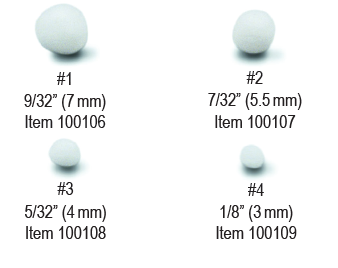
Richmond offers nonsterile 100% cotton medical balls in sizes medium and large.
What is the difference between a level 1 and level 3 face mask?
The right choice of protection will depend on the specific situation and procedure. The level of fluid and particle filtration of the mask material as depicted by its BFE and PFE specifications per ASTM F2101-19 Standards.
Richmond offers ASTM Level 1 and Level 3 face masks:
| Test | LEVEL 1 (LOW) BARRIER FACE MASK | LEVEL 3 (HIGH) BARRIER FACE MASK |
| BFE (Bacterial Filtration Efficiency at 3.0 micron ASTM F2101 | ≥ 95% | ≥ 98% |
| PFE (Particle Filtration Efficiency) at 0.1 micron ASTM F2299 | ≥ 95% | ≥ 98% |
| Delta P (Differential Pressure), mmH2O/cm2 MIL-M-36954C | < 4.0 | < 5.0 |
| Fluid Resistance to Synthetic Blood, mm Hg ASTM F1862 | 80 | 160 |
| Flame Spread 16 CFR part 1610 | Class 1 | Class 1 |
| USE | Low risk exposure | Higher risk and fluid exposure |